Salmon Stream Network Analysis
This project used GIS-based hydrologic modeling to derive a stream network from a digital elevation model (DEM) of Vancouver Island. Network analysis and linear referencing techniques were then applied to evaluate potential salmon spawning habitat based on stream accessibility, slope, and stream order. The analysis demonstrates how GIS can support watershed management and conservation planning.

Workflow
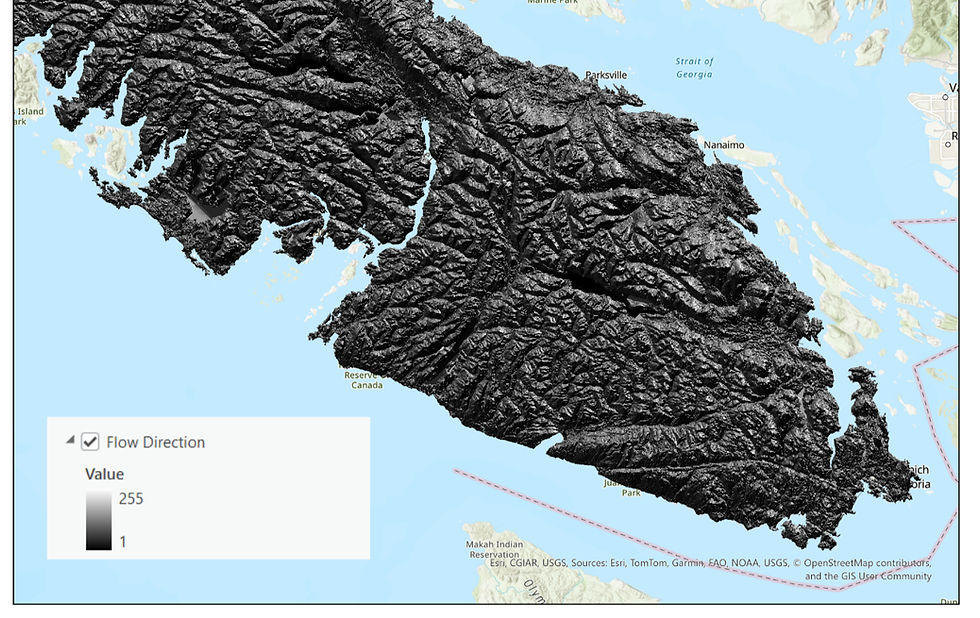
Step 1 – Derive Stream Network from a DEM
A digital elevation model (DEM) of Vancouver Island was processed in ArcGIS Pro using hydrology tools to calculate flow direction and flow accumulation. A threshold was applied to extract stream channels and convert them into vector stream segments representing the island’s drainage network.

Step 2 – Identify Stream Barriers
Stream segments were converted into network routes, and topology rules were applied to identify where dams intersect streams and where streams meet the ocean. These junction points represent barriers and entry points that influence salmon movement through the watershed.

Step 3 – Add Habitat Attributes to Streams
Linear referencing techniques were used to attach environmental attributes to each stream segment. Stream gradient and stream order were derived from the DEM and used as proxy indicators for salmon spawning habitat suitability.

Step 4 – Trace Accessible Salmon Habitat
A trace network analysis was used to simulate salmon migration from the ocean upstream while treating dams as barriers. Suitable spawning habitat was identified by selecting stream segments that were low gradient, low order, and reachable from the ocean.
Tools & Technologies
ArcGIS Pro
SQL